If Mt Pinatubo Went Off Again
2021-04-02
Stratospheric aerosols originate for the nearly part from volcanic eruptions and take a large influence on the Earth's atmosphere and climate. BIRA-IASB is involved in the monitoring of these aerosols, delivering loftier quality data to centralised databases like the Copernicus programme, to be integrated in climatological models, among other things.
Meet Mt. Pinatubo
For one-half a millennium, the Pinatubo volcano - located in the western part of the Philippines - had been lying dormant, peacefully allowing forest growth to embrace its flanks. Notwithstanding, xxx years ago, on April 2d 1991, the volcano suddenly awoke from its torpor. The mounting magmatic pressures inside Earth's chaff could no longer be contained. Later months of regular earthquakes, the northern flank of the mount finally cracked open up when rising magma came into contact with subsurface water, causing it to instantly turn to steam, causing a trigger-happy explosion.
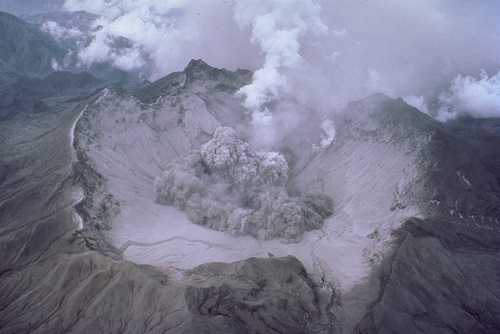
explosion on August one. Credit: T.J. Casadevall, U.S. Geological Survey
Information technology was merely a get-go, relatively small eruption though with respect to what had to come. A few weeks later, scientists arrived to monitor the new activity more closely. They registered the standing earthquakes, and in May, measurements of sulphur dioxide gas (Thentwo) escaping from the fissure began. The Then2 emissions were quickly increasing until the end of May, from 500 metric tons to 5000 metric tons, and and so substantially decreased over again, suggesting that something was blocking the degassing process and causing a build-up deep of gas undercover.
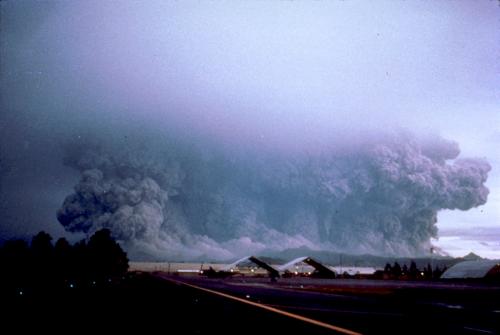
In June, small eruptions started occurring again, building upward to the true destructive potential of the Mt. Pinatubo's eruption, which the volcano displayed on June 15, 1991. The gas bubbles that had been rising and accumulating within the magma chamber and column for the by weeks exploded, forcing about 5 kmiii of matter into the stratosphere (eventually reaching altitudes up to 35 km) over a period of 9 hours, and resulting in the collapse of the mountain.
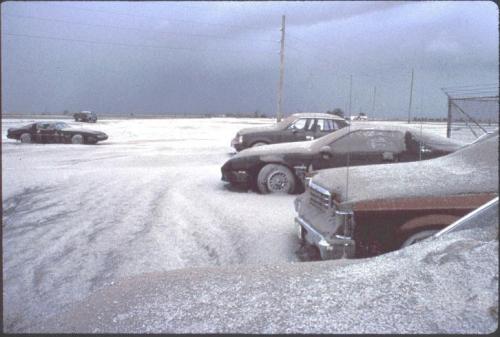
The firsthand consequences of the eruption luckily were limited by the preventive measures that had been taken, though many lives were still lost (an estimated 300-350 deaths were directly caused past the eruption, due to roofs collapsing nether the weight of the ashfall) and the cloth damage was substantial. Heavy rains that created subversive flows of volcanic debris (called Lahars) continued to plague the surrounding population in the ensuing years, adding upward to a total death price estimated between 750 and 850.
Touch of the Mt. Pinatubo eruption on the chemical composition of the stratosphere
The scope of the consequences went much further than that, though. The Mt. Pinatubo eruption of June 15, 1991, was the largest eruption in the concluding 100 years. The corporeality of sulphur injected - and dispersed in the entire stratosphere over a few months - was so large that information technology disrupted the propagation of light in the atmosphere for more than v years. In addition to this direct impact, which resulted in a cooling of the atmosphere by about 0.2 to 0.7°C (for the global troposphere), the volcanic cloud had multiple secondary effects. There were changes in the atmospheric dynamics and a huge touch on the chemistry and the chemical composition of the atmosphere (amidst which a decrease in the ozone layer of nigh 25%) and eventually, on the whole Earth climate system.
The plumes were more often than not composed of ash and sulphur in the form of sulphur dioxide (And then2), but likewise a whole range of other chemicals, including water vapour (H2O), were transported high up into the unremarkably dry out stratosphere. The actress water vapour allowed the So2 to oxidise into sulphuric acid (H2SOiv), and to form condensation nuclei for sulphate aerosols (fine droplets in suspension in the air) within weeks. In fact, volcanic eruptions, because of their tearing power, are a very effective way of providing the necessary ingredients for the formation of aerosols in the stratosphere, a very stable and difficult layer to penetrate.
Volcanic eruptions influence global temperatures
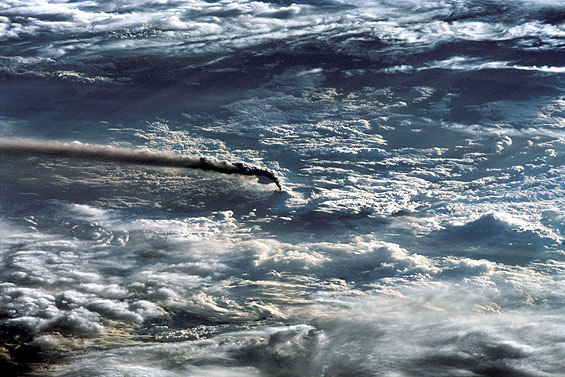
The stratospheric aerosol layer that Mt. Pinatubo created was able to block substantial amounts of solar radiation from reaching Earth'southward surface, resulting in a heating of the stratosphere by three.5°C, and a cooling of the troposphere of the northern hemisphere by 0.ii to 0.7°C. These may seem similar small numbers, merely in the atmospheric organisation, small changes accept big consequences. Information technology led to an increase in the temperature departure between the equator and the poles, which resulted in a strengthening of the atmospheric dynamic at the global calibration, of the polar vortex at mid-latitudes (a closed air current stream loop that isolates the polar atmosphere for several months in winter), and of a suite of other atmospheric oscillation phenomena.
At first, it was suggested that the Pinatubo eruption of 1991 also caused the unusually warm winter of the same year (in the northern hemisphere). However, recent studies performed with climate modelling neglect to reproduce this effect, showing that the two events were likely unrelated.
Volcanoes take always been important drivers of climate changes in Earth's history, since long before act became a cistron. This is why nosotros need to monitor the nature and book of the affair that volcanoes eject, but also the frequency of eruptions.
Monitoring stratospheric aerosols
We have discussed the effects that SO2 and aerosols of volcanic origin have on the Earth'southward climate and on the ozone layer, just these are not the just dangers. Volcanic eruptions like that of Mt. Pinatubo also grade a direct threat to aviation. Both the ash and gases that are released tin can cause substantial impairment.
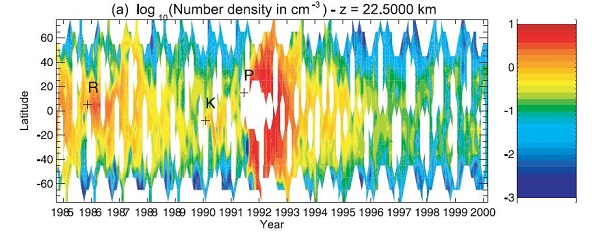
All these reasons illustrate the necessity for high quality data on both stratospheric and tropospheric sulphate aerosols. However, compared to atmospheric gases, aerosols are a particularly challenging object of written report. The fashion they besprinkle or absorb calorie-free is dependent on many variables like their size, composition, history and origin (there are other sources similar desert dust, anthropogenic pollution etc., though volcanism remains the chief source in the stratosphere). Atmospheric conditions or local features of atmospheric dynamics as well influence their microscopic characteristics.
This variability and the varying characteristics of the aerosol particles make it difficult for scientists to decipher what the satellite observations really represent. Researchers need to piece together what is happening in the temper based on incoming streams of numbers, which correspond the light signatures that remote-sensing satellite instruments have captured from their orbits.
At BIRA-IASB, we work on translating satellite information into meaningful information that tin can be used for other applications. We provide long-time serial, global datasets, or more than detailed local data for various atmospheric species, including stratospheric aerosols, to the European Copernicus programme. This information is centralised in international databases later precise and detailed characterisation, to be integrated in climate models, among other things.
References
- Bingen et al., 2004: A global climatology of stratospheric droplets size distribution parameters derived from SAGE Two data over the period1984–2000: 1. Methodology and climatological observations
- Polvani et al., 2022 : Northern Hemisphere continental winter warming following the 1991 Mt. Pinatubo eruption: reconciling models and observations
- Dhomse et al., 2022 : Evaluating the simulated radiative forcings, aerosol properties, and stratospheric warmings from the 1963 Mt Agung, 1982 El Chichón, and 1991 Mt Pinatubo volcanic aerosol clouds
- European Copernicus programme
News image 1
News paradigm fable 1
View from Clark Air Base of operations of the major eruption of Mt. Pinatubo on June 15, 1991. The June xv eruption lasted nine hours, sent droppings, ash and gases into the stratosphere, up to 35 km, generated voluminous pyroclastic flows (extremely fast "avalanches" of very hot gas and ash), and left a caldera (the crater subsequent to the collapse of the volcano) 2.v km in bore in the erstwhile summit region. Credit: R. Lapointe, U.S. Air Force
News epitome 2
News image legend ii
A 9 cm-thick layer of ash covering Clark Air Base, 25 km east of Mt. Pinatubo. Credit: R.P. Hoblitt
News image 3

News image fable three
Space Shuttle (Mission STS-43) photograph of the Earth over South-America taken on August 8, 1991, showing double layer of Pinatubo aerosol deject (dark streaks) above high cumulonimbus tops. Credit: NASA
Source: https://www.aeronomie.be/en/news/2021/30-years-after-mt-pinatubo-eruption-illustration-relationship-between-volcanoes-and
0 Response to "If Mt Pinatubo Went Off Again"
Post a Comment